WORK · 01 · 6 MIN
Tell payroll your new work state the week you move
Withholding follows where you work and where you live; with a New York office, New York counts home days as New York days, and IT-2104.1 gives you 10 days.
Give payroll your new address and your new work pattern the week you move, because state withholding follows both. Connecticut's Department of Revenue Services describes the usual split: the employer withholds for the state where the work is done, and the home state taxes all of a resident's income. New York changes the answer for anyone whose primary office is there: its telecommuting FAQ, updated October 24, 2025, counts a day worked from home outside the state as a New York day unless the employer has established a bona fide employer office at that home. New York's Form IT-2104.1 gives you 10 days to tell your employer when that changes.
Your work state withholds first, and your home state taxes everything
The Connecticut DRS page spells the pattern out. A Connecticut resident is taxed on all income, wherever it is earned. The employer withholds for the state where the work is done; if it is also registered in Connecticut, it withholds Connecticut tax only to the extent that it exceeds the other state's. Connecticut then credits tax paid to the other state "on income earned for services performed in the other state," up to the lesser of the two taxes.
New York puts it the same way in its FAQ: living in one state and working in another can create tax in both, and the home state typically gives a credit. The same page settles the city question. Nonresidents of New York City are not liable for the city's personal income tax, but a city domicile changes only when you can show, by clear and convincing evidence, that you left it for a new one.
New York counts a telecommuting day as a New York day
The rule applies when your assigned or primary work location is a New York office. The 2025 instructions for Form IT-203 say days worked outside the state count only when the duties require it, "because of necessity (not convenience) of the employer," and that normal work days spent at home count as New York work days. A home day that is not a normal work day is a nonworking day. Answering an occasional email does not make it a work day, according to the Tax Department's 2006 memorandum TSB-M-06(5)I. The office address decides.
Moving to a state with no wage tax does not change it either. New York taxes a nonresident's New York-source wages, so the nine states that tax no wages remove only the home-state tax.
A bona fide employer office is the one exception
The same memorandum lists the tests. A home office qualifies if it meets the primary factor, specialized facilities that cannot be made available at the employer's office, or at least four of six secondary factors and three of ten other factors. Secondary factors include the home office being a condition of employment, the employer providing no designated desk at its own offices, and the employer reimbursing at least 80 percent of the home office's expenses. Other factors include a separate business phone line, a sign, and business records kept at the home. The telecommuting FAQ adds the practical test. In general, the employer has to act.
Delaware, Nebraska and Pennsylvania tie remote days to the employer's needs
Delaware's 2025 Schedule W worksheet allows days outside Delaware only when the work is a necessity for the employer, and treats a home office as the employee's convenience unless working from home is a requirement of employment. Nebraska's 2026 Circular EN defines "convenience rule wages" as pay for work done outside Nebraska for the employee's convenience; an employer withholds nothing on them while the employee works seven employment duty days or fewer in Nebraska, and above seven withholds only on the days worked there. Pennsylvania's telework guidance treats a nonresident who is required to telework full-time from another state as earning non-Pennsylvania income, with no Pennsylvania withholding required. The word that matters is required.
Connecticut and New Jersey borrow the rule for some neighbors
Since tax year 2019, the Connecticut DRS applies a convenience test to nonresidents working for a Connecticut employer only when their home state has one; a New York resident telecommuting for a Connecticut employer is judged by New York's test. New Jersey followed for tax years from 2023. Its Division of Taxation applies the home state's rule to residents of states such as Delaware, Nebraska and New York who work for a New Jersey employer, but not to Pennsylvania residents, who are covered by a reciprocal agreement. Connecticut residents are left out too.
Example: a Manhattan office and a new home in Stamford
Example: an employee whose primary office is in Manhattan moves from Brooklyn to Stamford, Connecticut, and keeps a schedule of two office days and three home days a week. The certificate for this is Form IT-2104.1, and its own instructions show the arithmetic: working in New York State two of five days for the year is 40 percent of services.
Scroll sideways to see the full table →
| Home office status (TSB-M-06(5)I) | New York days a week (NY Tax Department) | Percent on IT-2104.1 (NY Tax Department) |
|---|---|---|
| No bona fide employer office | 5 of 5 | 100% |
| Bona fide employer office in Stamford | 2 of 5 | 40% |
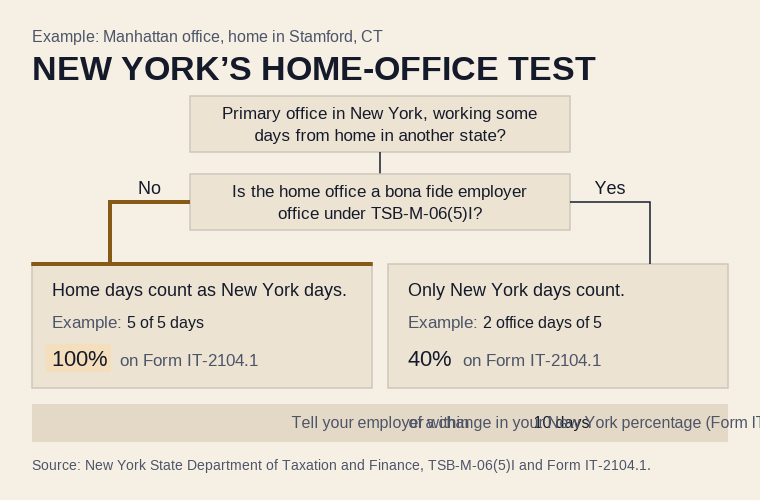
Three home days are the difference. Part 2 of Form IT-2104.1 certifies that she is no longer a New York City resident. The form requires her to notify the employer within 10 days of a change in her New York percentage or residence, and carries a $500 penalty for false information that lowers withholding. Her employer withholds New York tax on the percentage she certifies; under the Connecticut DRS rule, it withholds Connecticut tax only where Connecticut's exceeds New York's, and only if it is registered in Connecticut. Relocation pay on the same paycheck is withheld as wages.
Scorecard
- Give payroll your new home address and your weekly split of office days and home days in the move week.
- With a New York office, home days count as New York days unless it's a bona fide employer office.
- File Form IT-2104.1 with your New York percentage: 2 of 5 days is 40%, 5 of 5 is 100%.
- Tell your employer within 10 days whenever that percentage or your residence changes (IT-2104.1).
Also in Work
Sources
- Withholding Tax Information (Connecticut Department of Revenue Services)
- Frequently Asked Questions about Filing Requirements, Residency, and Telecommuting for New York State Personal Income Tax (updated October 24, 2025)
- Form IT-2104.1 (12/24): New York State, City of New York, and City of Yonkers Certificate of Nonresidence and Allocation of Withholding Tax
- Instructions for Form IT-203, Nonresident and Part-Year Resident Income Tax Return (2025)
- TSB-M-06(5)I: New York Tax Treatment of Nonresidents and Part-Year Residents, Application of the Convenience of the Employer Test to Telecommuters and Others (May 15, 2006)
- 2025 Delaware Schedule W, Apportionment Worksheet (PIT-SCW), Delaware Division of Revenue
- Circular EN Instructions for wages paid on or after January 1, 2026 (Nebraska Department of Revenue)
- Telework Guidance (Pennsylvania Department of Revenue)
- Convenience of the Employer Sourcing Rule Enacted for Gross Income Tax FAQ (New Jersey Division of Taxation)
Opened while researching this guide. Figures and rules can change; check the source before you act.