THE MOVE · 02 · 5 MIN
Released value pays 60 cents a pound; choose full value
Released value pays 60 cents a pound, $6 for a 10-pound, $1,000 stereo; full value protection repairs or replaces, at $6 a pound unless you declare more.
Keep full value protection on an interstate move, and declare a higher value when your goods are worth more than the default. Released value, the alternative, costs nothing extra and pays no more than 60 cents a pound per article under 49 CFR 375.303; FMCSA's valuation brochure, updated in 2023, puts a lost 10-pound stereo component valued at $1,000 at $6.00 under it, and says your shipment moves under full value unless you select released value. The condition that changes the payout is the declared value: without one, the Surface Transportation Board's released rates decision, served January 12, 2012, deems your goods worth $6.00 a pound times the shipment's weight, with a $6,000 minimum.
Released value pays by the pound, not by the item
49 CFR 375.203 and 49 CFR 375.303 set released value at 60 cents a pound ($1.32 a kilogram) per article. To choose it you initial and sign a waiver in the valuation statement on the bill of lading, the wording the STB decision prescribes, and any claim is then settled at the article's weight times 60 cents. Weight decides the payout. 49 CFR 375.201 lets a mover raise the released rate each year by the Commerce Department's cost-of-living adjustment, so read the rate on your own bill of lading.
Released value is also the only case in which a mover may sell you liability insurance, under section 375.303, and a mover that sells it without giving you the policy or other evidence becomes fully liable for your claims. FMCSA's brochure explains the split: the mover stays liable up to 60 cents a pound, the insurer covers the rest up to the amount you bought, and state law governs that insurance.
Full value repairs, replaces or pays, up to your declared value
Under 49 CFR 375.201, full value protection makes the mover liable for the replacement value of lost or damaged goods, up to the shipment's declared value. Appendix A to Part 375 lets the mover choose to repair the item or pay for repairs, or to replace it with one of like kind and quality or pay the replacement cost; it adds that your first cost estimate must include this protection and that a mover may use a higher minimum than $6.00 a pound. The STB decision lets movers offer deductibles, such as $250 or $500, that lower the charge. One limit needs your action: under section 375.203, a mover may cap an article worth more than $100 a pound at $100 a pound unless you list it in writing.
Example, with published weights: Apple lists its 24-inch iMac, 2-port model, at 9.74 pounds. FMCSA's brochure uses a 10-pound stereo component valued at $1,000. And 49 CFR 375.407 uses a 5,000-pound shipment in its own example.
Scroll sideways to see the full table →
| Loss | Weight | Released value, 60 cents a pound (49 CFR 375.303, 2026) | Full value, no declared value (STB, 2012) |
|---|---|---|---|
| iMac destroyed | 9.74 lb | $5.84 | Repair or replacement; $974 cap if worth over $100 a pound and not listed |
| Stereo component lost | 10 lb | $6.00 | Repair or replacement of a $1,000 item |
| Whole shipment lost | 5,000 lb | $3,000 | Up to $30,000 |
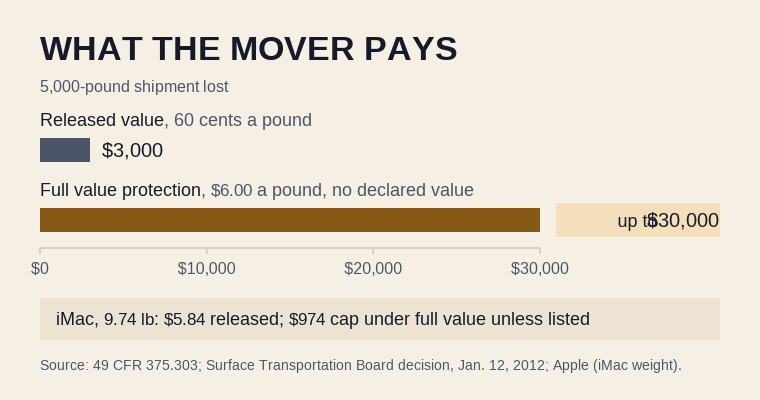
The arithmetic is short. At 60 cents, 9.74 pounds pays $5.84 and 5,000 pounds pays $3,000. Under the STB default, 5,000 pounds times $6.00 is $30,000, above the $6,000 floor. An iMac bought for more than $974 is worth over $100 a pound, so list it. The stereo sits at exactly $100 a pound, which is not over the line. If replacing your whole household would cost more than $30,000, write the higher value on the bill of lading.
File within 9 months; the mover answers within 120 days
Appendix A to Part 375 gives you 9 months from delivery to file a claim, or from the date delivery should have happened if the whole shipment is lost. Under 49 CFR 370.3, a claim is a written communication that identifies the shipment, asserts the mover's liability and asks for a specified or determinable amount; damage noted on a delivery receipt or inventory is not a claim on its own. A phone call is not a claim. The mover must acknowledge it within 30 days under 49 CFR 370.5, and pay, decline or make a firm settlement offer in writing within 120 days under 49 CFR 370.9, with a written status update every 60 days after that.
In the same example, delivery on Tuesday, November 10, 2026, leaves until Tuesday, August 10, 2027, to file. A claim the mover receives on Monday, November 16, 2026, must be acknowledged by Wednesday, December 16, and answered by Tuesday, March 16, 2027. The price of full value belongs in the estimate, so compare binding and non-binding estimates with it included, and check the mover's USDOT number before you sign.
Scorecard
- Leave the released value waiver on the bill of lading unsigned; released value pays 60 cents a pound.
- Declare a value above $6 a pound times your shipment's weight if replacing it all would cost more.
- List in writing each article worth over $100 a pound, such as a 9.74-pound iMac that cost over $974.
- File a written claim within 9 months of delivery; the mover must answer within 120 days.
Also in The move
Sources
- 49 CFR 375.303: If I sell liability insurance coverage, what must I do?
- Understanding Valuation and Insurance Options (FMCSA Protect Your Move fact sheet)
- Released Rates of Motor Common Carriers of Household Goods, Docket No. RR 999 (Amendment No. 5), STB decision served January 12, 2012
- 49 CFR 375.203: What actions of an individual shipper may limit or reduce my normal liability?
- 49 CFR 375.201: What is my normal liability for loss and damage when I accept goods from an individual shipper?
- Appendix A to Part 375: Your Rights and Responsibilities When You Move
- iMac Technical Specifications (Apple)
- 49 CFR 375.407: Under what circumstances must I relinquish possession of a collect-on-delivery shipment transported under a non-binding estimate?
- 49 CFR 370.3: Filing of claims
- 49 CFR 370.5: Acknowledgment of claims
- 49 CFR 370.9: Disposition of claims
Opened while researching this guide. Figures and rules can change; check the source before you act.