THE NUMBERS · 03 · 6 MIN
Get a binding estimate: a non-binding one can grow 10% at delivery
A binding estimate is the price; on a non-binding one, FMCSA's rule lets a mover demand up to 110% at delivery and bill the balance 30 days later.
Ask each interstate mover for a binding estimate in writing. Under FMCSA's household goods rule as it stands in September 2026, a binding estimate is the price you pay for the goods and services it lists, while a non-binding estimate lets the mover demand up to 110 percent of it at delivery and bill the rest afterward. Take a non-binding estimate only when your inventory may still shrink before the truck arrives: its final charges follow the actual weight, and a binding price does not fall when you ship less.
A binding estimate is the price; a non-binding one is a forecast
49 CFR 375.401 requires a written estimate before the bill of lading and makes the mover say which kind it is. A binding estimate guarantees the total cost for the quantities and services it shows, and the mover may charge you for preparing it. A non-binding estimate is what the mover believes the move will cost; it must be free, and the final bill follows your shipment's actual weight and the mover's tariff. You and the mover both sign the estimate, and you get a dated copy.
The rule names only those two kinds. A quote sold as "not to exceed" holds the mover at delivery only if it says on its face that it is binding, which 49 CFR 375.403 requires of every binding estimate. A non-binding estimate must state on its face that you will not pay more than 110 percent of it at delivery, under 49 CFR 375.405. FMCSA's Ready to Move brochure, revised October 2022, adds two habits: get estimates from at least three movers, and do not accept oral ones.
The survey sets the estimate, and loading freezes it
Section 375.401 bases every estimate on a physical survey of your goods, which 49 CFR 375.103 defines as on site or by live or recorded video, unless you waive it in writing before loading. Either kind of estimate can be changed by mutual agreement before loading. After loading, neither can. Charges for elevators or long carries must be settled before the bill of lading; under the same section, a mover that failed to ask must deliver and bill them after 30 days.
Adding furniture on moving day reopens a binding price. Section 375.403 then gives the mover three choices before loading: reaffirm the estimate, write a new binding estimate that you sign, or agree with you in writing to treat it as non-binding. A mover that loads without doing any of those has reaffirmed the original and may not collect more than it, apart from the extras below.
At delivery you owe 100 or 110 percent, plus capped extras
49 CFR 375.703 sets the most a mover may demand at delivery: the exact binding estimate, or 110 percent of a non-binding one. Two extras can be added either way. One is services you requested after the bill of lading was issued. The other is charges for impracticable operations, as the mover's tariff defines them, which the same section caps at 15 percent of all other charges due at delivery.
The balance on a non-binding estimate comes later. Appendix A to Part 375, the "Your Rights and Responsibilities" booklet your mover must give you, says the mover bills remaining charges after 30 days from delivery. If you offer 110 percent and the mover keeps your goods, 49 CFR 375.407 counts that as a failure to transport with reasonable dispatch, and the booklet calls it holding your shipment hostage. The same section limits a partial delivery to the delivered share by weight: 50 percent of the estimate for 2,500 pounds of a 5,000-pound shipment.
Example: one $6,000 estimate, binding or not
Example: a mover quotes $6,000 to move a household from Raleigh, North Carolina, to Columbus, Ohio, an amount we chose for illustration because no public price list covers a single move. On moving day the goods weigh more than the survey showed, and the tariff charges at actual weight come to $6,900, 15 percent over the estimate. Delivery is Tuesday, November 10, 2026.
Scroll sideways to see the full table →
| Measure | Binding estimate (49 CFR 375.403, 2026) | Non-binding estimate (49 CFR 375.405, 2026) |
|---|---|---|
| Fee for the estimate | Allowed | Not allowed |
| Tariff charges at actual weight | Do not apply | $6,900 |
| Most due at delivery (49 CFR 375.703) | $6,000 | $6,600 |
| Cap on impracticable operations at delivery, 15% | $900 | $990 |
| Balance billed later | None | $300 |
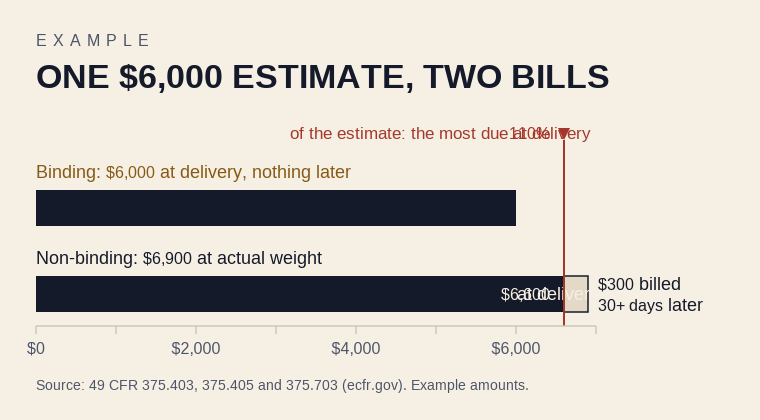
On the binding estimate you pay $6,000 and are done. On the non-binding one you pay $6,600 at the door, 110 percent under section 375.703, and get a bill for the last $300 no sooner than Thursday, December 10, 2026, 30 days after delivery under Appendix A. Had the goods come in light, at $5,400 in tariff charges, you would owe $5,400 on the non-binding estimate and still $6,000 on the binding one. That $600 is the price of certainty.
Before you sign either estimate, check the mover's USDOT number and decide whether to keep full value protection, which Appendix A says your mover's first cost estimate must include.
Scorecard
- Ask three interstate movers for written estimates based on a physical survey of your goods.
- Pick one marked binding on its face; a non-binding estimate is free but can cost 110% at delivery.
- Add or remove items in writing before loading; neither estimate can change once the truck is loaded.
- At delivery, pay 100% of a binding or 110% of a non-binding estimate; the rest is billed 30+ days later.
Also in The numbers
Sources
- 49 CFR 375.403: How must I provide a binding estimate?
- 49 CFR 375.405: How must I provide a non-binding estimate?
- 49 CFR 375.401: Must I estimate charges?
- Ready to Move? Tips for a Successful Interstate Move (FMCSA-ESA-03-005, revised October 2022)
- 49 CFR 375.703: What is the maximum collect-on-delivery amount I may demand at the time of delivery?
- Appendix A to Part 375: Your Rights and Responsibilities When You Move
- 49 CFR 375.407: Under what circumstances must I relinquish possession of a collect-on-delivery shipment transported under a non-binding estimate?
- 49 CFR 375.103: What are the definitions of terms used in this part?
Opened while researching this guide. Figures and rules can change; check the source before you act.